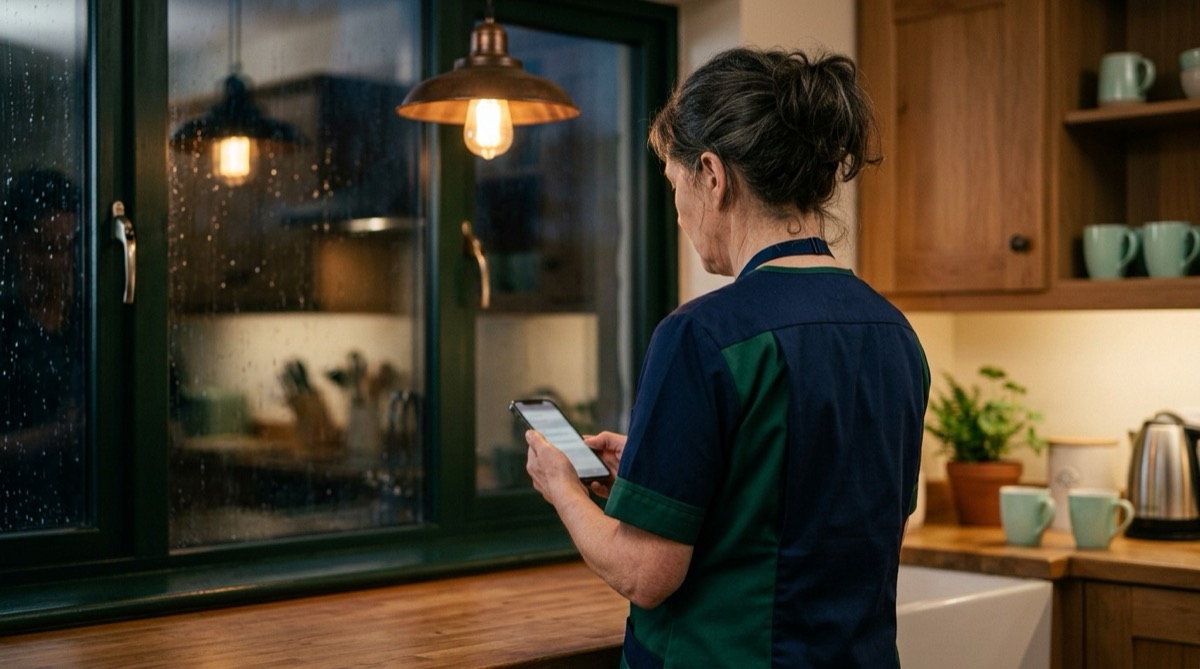
Hospice out of hours is the stretch of the week when families are most likely to ring and least likely to find someone who knows them. Between 8pm and 8am, a spouse or daughter may be watching a person they love struggle with pain, breathlessness or distress. They ring the number on the fridge. What happens in the first minute decides whether they feel held or abandoned.
This article is for hospice and community palliative care teams, and for home care agencies that support people at the end of life. It looks at what families need on that call, what a non-clinical first layer can safely do and how to protect your nurses while keeping every serious call in front of a human.
What the evidence says about out-of-hours calls
Irish research gives a clear picture of the clinical side. A national survey of specialist palliative care out-of-hours telephone advice, published in BMJ Supportive and Palliative Care in 2024, collected responses from 78 clinical staff who give that advice and 23 managers. Symptom management was the most common type of call, at 97%. Seventy-three per cent of staff had no specific training in giving advice over the phone, and 44% felt ill equipped and uncomfortable doing it. The authors concluded that staff need support and training and that standards to guide practice would be useful.
Two lessons follow. First, your nurses are carrying a hard job with little preparation. Second, anything that makes their calls shorter, better informed and better prepared is worth having. A nurse who picks up the phone already knowing who is ringing, about whom, and what has been said, can spend the first minute on care.
Why families ring hospice out of hours
Many families ring because something has changed and they need a person to share the weight. Typical triggers are a new or worse symptom, a medicine that does not seem to be working, a night with no sleep, a fear that death is close or a person who has died at home and a family who does not know what to do next.
Place of death shapes this. In an ESRI-published study in the Journal of Palliative Care, preferred and actual place of death matched in 51% of cases, and people who lived alone were less likely to die at home. The data were collected in 2011 to 2015, so treat the figures as indicative. The picture is still useful. Some families are trying to make a home death possible, and the night is when that effort is most fragile.
For a family at three in the morning, the first answer matters more than the best answer. It needs to be a calm voice, a clear next step and a promise that is kept.
What a good first minute sounds like
A good first minute does four things.
- Answers fast and warmly. The phone is picked up, and the voice is kind.
- Gets the basics. Name, who the patient is, a number to call back and one sentence on what is happening.
- Decides the route. Emergency, urgent or can wait.
- Tells the caller what happens next. "I am putting you through to the on-call nurse now. Please stay on the line."
If the caller describes something that sounds like an emergency, such as trouble breathing, a collapse or severe bleeding, the answer is to ring 112 or 999 and alert the on-call nurse at the same time. A first layer should never talk a family out of calling an ambulance.
What a non-clinical first layer can and cannot do
You can use a person, an answering service or an automated voice as the first layer. Whatever you choose, the boundary is the same.
It can:
- answer every call, however many come at once;
- speak kindly and let the person finish;
- record who is calling, about whom, and what they say, in their own words;
- put the call through live to a nurse when the rules say so;
- text or ring the nurse and the manager when a call is urgent;
- tell the family the opening hours of the office and the number to ring again;
- produce a clear summary for the morning team.
It cannot, and must not:
- advise on doses, missed doses or changes to medicines;
- interpret a symptom or say it is "probably nothing";
- tell a family not to call an ambulance or not to wait for a nurse;
- say anything about prognosis.
That list is a safety rule. It protects the family and the nurse, and it keeps you on the right side of your clinical governance. Hettie is built to work within it. It records, routes and escalates, and it passes questions about medicine or symptoms to the nurse.
Writing the rules for hospice calls
Your rules will be more specific than a home care agency's, because the situations are different. Write them with your medical director or lead nurse, and review them on a schedule. Our guide to writing on-call escalation rules offers a template. For hospice, start with these questions.
- Pain or distress reported by a family. Who is called, how fast, and what if they do not answer?
- Uncontrolled symptoms. Which words or phrases always trigger a live transfer?
- A death at home. Who speaks to the family first, who informs the GP and what does the family do while they wait? Agree the wording with your clinical lead. A first layer should hand this call to a nurse at once.
- A family carer who cannot cope. This is urgent. It may need a visit, extra support or a change of plan.
- Callers who are not family. GPs, out-of-hours doctors, ambulance services and pharmacists need a different route.
- Callers at risk of harm. If a caller says they want to end their life, the rules should include 112 or 999 and a Samaritans option on 116 123, alongside an urgent alert to your on-call lead.
Test every rule with a real call.
Protect your nurses
A nurse who is woken for every routine question will burn out. The aim of a first layer is to make sure the calls nurses take are the ones that need them, and that each arrives with context.
Three simple changes help.
- Give nurses the summary before they speak. A whispered line such as "Urgent call from Mrs Byrne about her husband, severe pain, meds not working" saves a minute of questioning.
- Make the second attempt automatic. If the first nurse does not answer in a set time, the system or the rota should try the next.
- Keep routine matters for the morning. A request to change a visit time can wait. It should still be written down and answered.
Our article on home care after hours phone cover compares the staffing models in more detail, and the companion piece on answering services, on-call rotas and AI voice agents sets out where each fits.
A handover note nurses can use
A good note answers five questions in a few lines.
- Who is the patient and who is calling?
- What is happening now, in the caller's words?
- What has already been done or tried?
- What number should the nurse call back on?
- What was the caller told would happen next?
The note should travel with the call, whether it is a spoken line before a live transfer or text sent at the same time. Over a month, review a few and ask the nurses whether each had what they needed.
The morning after matters
Families remember the call. They also remember whether anyone followed it up. Build a morning routine.
- Read the overnight summary before the team meeting.
- Ring every family that called in distress, even if the night nurse resolved it.
- Record what changed in the care plan.
- Review any call that went badly, with kindness and curiosity.
If a patient has died, stop every scheduled or automated call to them and to their family contacts straight away. Add that step to your checklist for whoever records the death. A reminder or survey call arriving after a bereavement is the worst error an operations team can make.
Starting small
You do not need to rebuild your service. Pick the busiest hour, the most common kind of call and one change. It might be a shared template for notes, a clearer script for the first minute or a rule that pain always reaches a nurse live. Make the change, record what happens for a month and adjust. If you would like to see how our after-hours coverage handles routing for care teams, the Care Centre page has the detail.
Sources
Frequently asked questions
Can a non-clinical service answer hospice calls out of hours?
It can answer, record, comfort and route. It cannot give clinical advice. The calls that matter, such as uncontrolled pain, distress or a death at home, must reach a nurse. Write the rules with your medical director and test them.
What should a family be told when they ring and the nurse is busy?
Tell them honestly what will happen: that the call is marked urgent, who will ring back, and about how long it should take. Give them the number to ring again and remind them that for an emergency they should ring 112 or 999.
How do we avoid ringing a family after the patient has died?
Make it a step in your process. When a death is recorded, cancel every scheduled call to the patient and family contacts, and note it in the handover. Check the schedule the next morning to confirm.